
Cultural Triangle
Sigiriya
Where history rises above the jungle.
Why Visit
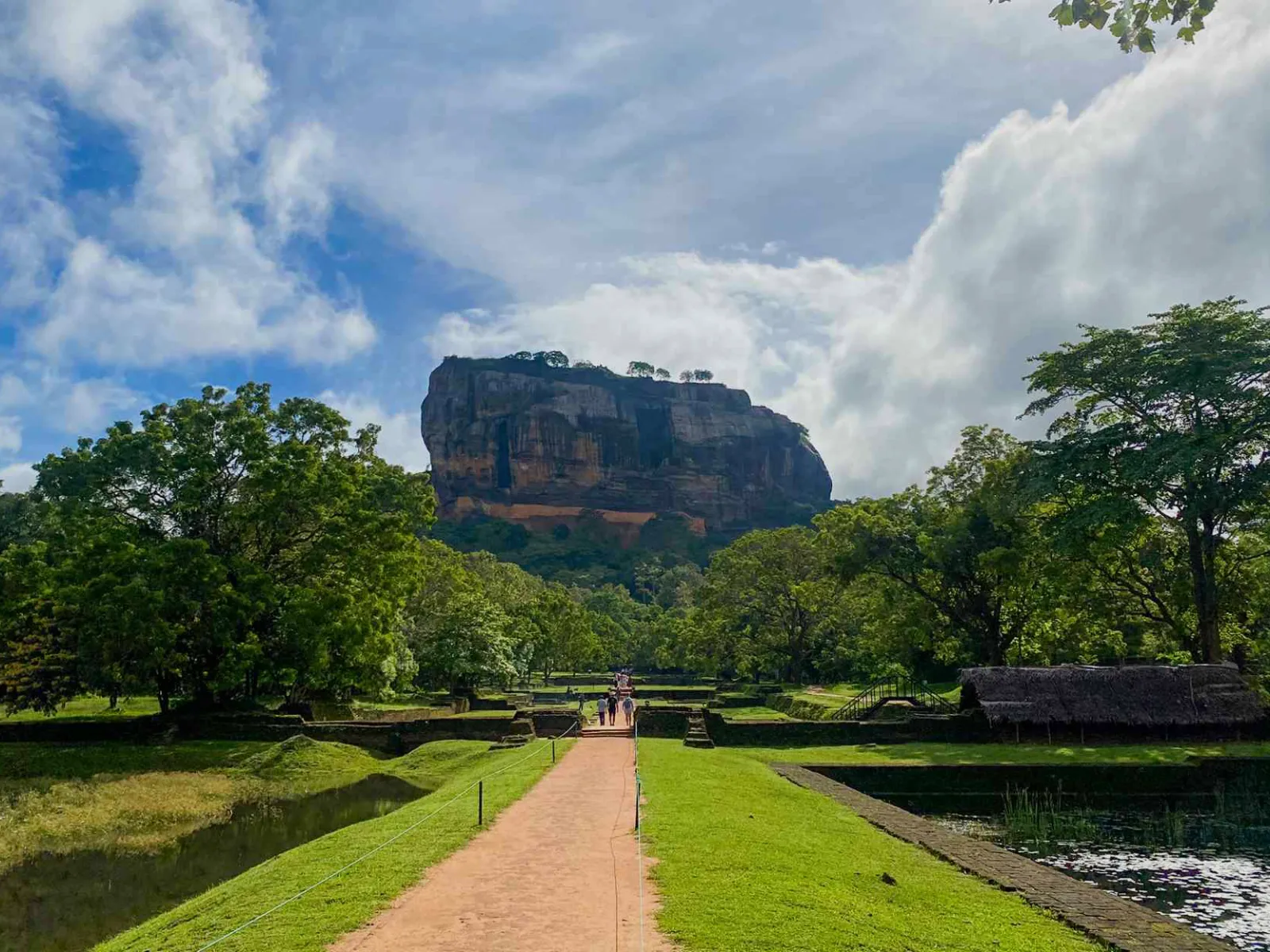
A 5th-century rock fortress built atop a 200-metre granite outcrop, with frescoes, mirror-polished walls and water gardens still traceable at its base.
Climb the ancient rock fortress of Sigiriya and look out over a landscape unchanged for centuries, where royal ruins meet the wild forest canopy below.
History
Long before it was a palace, Sigiriya's rock shelters were used by Buddhist monks as a monastic retreat, with inscriptions at the site dating that use back to around the 3rd century BCE. Its transformation into a fortress-palace came around 477 CE, when King Kashyapa seized the throne from his father, Dhatusena — reportedly having him killed — and moved the capital here from Anuradhapura, apparently out of fear of reprisal from his half-brother Moggallana, the rightful heir who had fled to India. In under two decades, Kashyapa's engineers built the summit palace, the elaborate symmetrical water gardens at the rock's base, and an entrance gateway shaped as a giant lion, of which only the two paws survive today and give the rock its name (Sinhagiri, "Lion Rock"). The frescoes of the so-called cloud maidens, painted partway up the rock face, are the surviving fraction of a much larger gallery that once wrapped much of the western face. Even the Mirror Wall below them became an accidental historical record: visitors from as early as the 8th century scratched verses and comments into its polished surface, leaving behind one of the richest troves of early Sinhala poetry known to scholars. Kashyapa's reign ended in 495 CE, when Moggallana returned with an army and defeated him in battle; the capital moved back to Anuradhapura, and Sigiriya was handed over to Buddhist monks once again, who maintained it as a monastery for several more centuries before it was eventually abandoned. The site lay largely forgotten by the outside world until British surveyor and army officer Jonathan Forbes rediscovered it in 1831, with systematic archaeological excavation following through the 20th century under Sri Lankan and international teams. It was inscribed as a UNESCO World Heritage Site in 1982.
Things to Do
- Climb to the summit palace ruins
- View the 5th-century Sigiriya frescoes
- Walk through the Lion's Paw entrance
- See the ancient graffiti on the Mirror Wall
- Walk the symmetrical water gardens at ground level
- Visit the Sigiriya Museum at the site entrance
- Climb neighbouring Pidurangala Rock for a view back at Sigiriya
- Watch sunrise or sunset over the surrounding jungle
Frequently Asked Questions
What is Sigiriya known for?
A 5th-century rock fortress built atop a 200-metre granite outcrop, with frescoes, mirror-polished walls and water gardens still traceable at its base.
When is the best time to visit Sigiriya?
The best time to visit Sigiriya is January to March, in the Cultural Triangle's dry season.
What can you do in Sigiriya?
Popular things to do in Sigiriya include climb to the summit palace ruins, view the 5th-century Sigiriya frescoes and walk through the Lion's Paw entrance.
Where is Sigiriya located in Sri Lanka?
Sigiriya is located in Cultural Triangle, Sri Lanka.
Your Journey Awaits
Your Sri Lankan Story
Starts Here.
Tell us how you want to travel, what you want to discover and the moments you hope to experience. Let Kingsbury help turn it into a journey worth remembering.